I recently facilitated a team coaching session at an industrial company where the leader's objective was to strengthen cohesion.
Earlier, I conducted individual and confidential interviews with each member of the team. It emerged that the team consisted of brilliant, qualified, experienced individuals. So where was the problem?
When I asked them to express how they worked together, their answers didn't surprise me.
The unspoken things hang in the air. The meetings often end with a " "We'll talk about it again" or worse, polite silence “there isn't enough questioning” “decisions take weeks” “we don't really talk to each other"
This moment has been a turning point. Because trust isn't an abstract word. It's what allows people to dare to say what matters, when it matters.
And when that's missing, everything freezes.
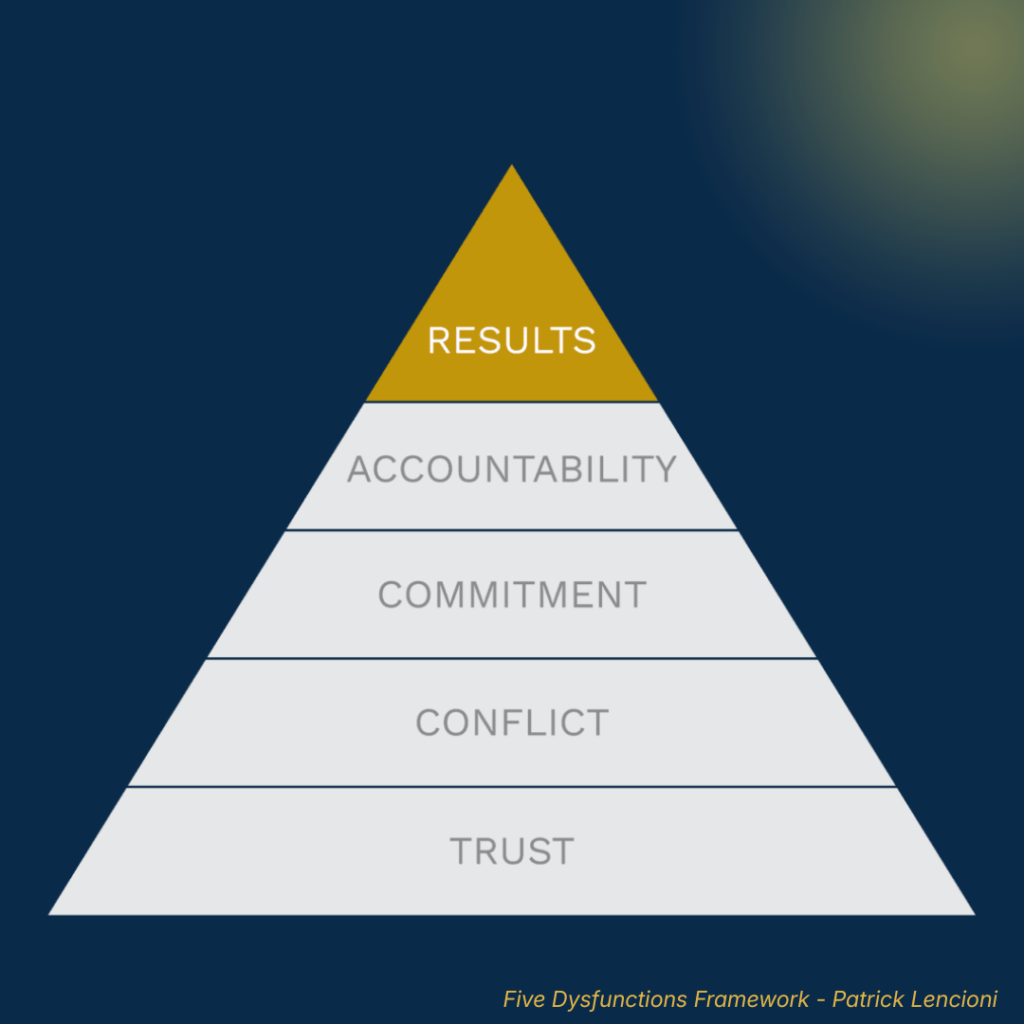
Patrick Lencioni says it straight: a lack of trust is the root of all team dysfunction. Its pyramid, simple and powerful, reminds us that trust is the foundation. If this foundation is fragile, everything else collapses: the quality of exchanges, decision-making, collective commitment, and ultimately, results.
It's the ability within a team to be able to say to each other:
«I don't know.»
«I need help.»
«I've made a mistake.»
«I can learn from you.»
When this trust exists, it opens the way for:
- Healthy conflicts : we tell each other things, without trampling on each other.
- Real engagement (we don't pretend to agree)
- shared responsibility : we are collectively accountable for the result
- results-oriented : we move forward, together
The pillar of trust transforms a group of people into a true team.
And, when trust is lacking, the dynamics change:
The team members no longer show their vulnerabilities.
They take on roles: the competent, the fortress, the “Everything is fine”, the “I control everything”.
So what
- We avoid difficult subjects.
- We steer clear of productive conflicts
- Decisions become lukewarm or slow
- The collective energy is running out
- Performance erodes
The LumApps study, published in l’ADN (2023), shows that only 21% Employees state that they have full confidence in their leaders.
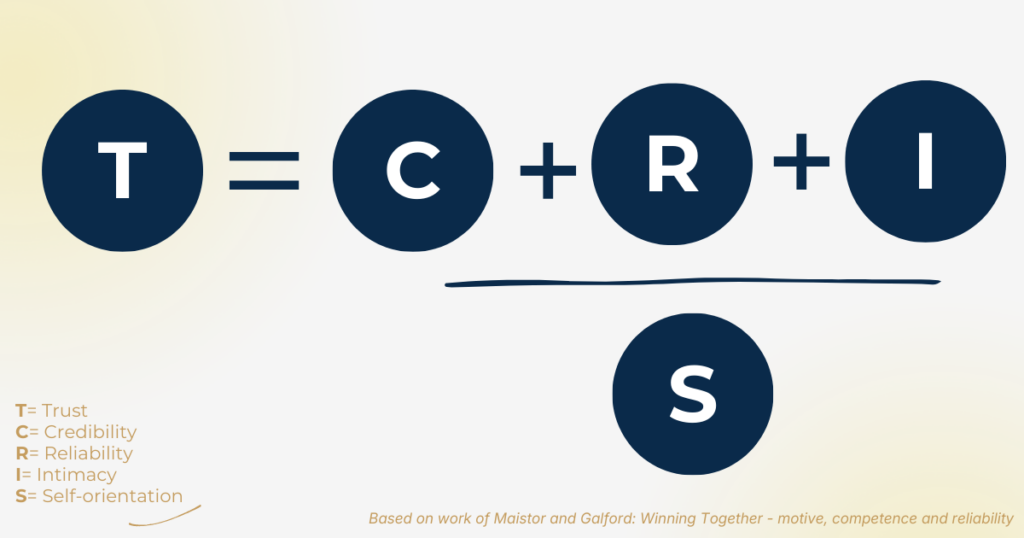
In my coaching, I often use a framework that complements Lencioni perfectly: Maister & Galford's equation of trust. It allows us to understand Why trust is built (or deteriorates!)
Here it is:
Trust = (Credibility + Reliability + Intimacy) / Self-orientation
In other words: trust increases when the first three elements advance, and decreases when self-orientation is too strong.
Credibility: “Do I believe you?”
In the team I was supporting, the leader was undeniably competent. However, several colleagues told me: «We don't always understand how he makes decisions.»
Credibility is not only based on expertise, it is also based on transparency of reasoning.
Immediate practice: When making an important decision in the future, explicitly state: «This is what I have mastered. This is what remains unclear. This is what I am basing my decision on.»
2) Reliability: “Can I count on you?”
Within this same team, some decisions were made… and then questioned a few weeks later. Nothing malicious, but enough to undermine trust. Reliability is the consistency between what we say and what we do.
Immediate practice: at the end of each meeting, clarify;
- Who does what?
- Until when?
- With what resources?
And keep your promises, even the small ones. Especially the small ones.
3) Intimacy: “Can I be myself with you?”
This isn't about friendship, but psychological safety: being able to say “I don't know” without losing credibility.
In this committee, no one dared to show their doubts. Everyone was playing a part. But a team that never shows its vulnerabilities cannot learn together.
Immediate practice:
Start a meeting with: «How are you really today?»
Now listen. Without interrupting.
4. Self-orientation: the real brake on confidence
This is the denominator of the equation. The stronger it is, the more confidence drops – even if you are credible and trustworthy.
It manifests when:
- We talk to big ourselves up
- We protect our image rather than tell the truth
- We seek to “be right” rather than to find the best solution
Immediate practice: Before you speak, ask yourself: “Am I speaking to help the collective... or to put myself forward?”
If you want to get a pulse on your team, I recommend you do the Lencioni's 5 Dysfunctions Test.
In 10 to 15 minutes, it allows you to:
- Measure the confidence level
- Identify the points of support and areas of tension
- Put words (and numbers) to often vague perceptions
It's not always comfortable, but it's an excellent starting point to open essential conversations.
And often... liberating.
We often hear: «Trust cannot be decreed... it takes time.»
And I reply: Yes, but how much time do you have to achieve your goals?
Because deep down, it's lack of confidence that makes you lose them.
Companies with a high level of trust demonstrate:
| Indicator | Result |
| Stress | -74% |
| Energy at work | +106% |
| Productivity | +50% |
| Engagement | +76% |
| Burnout | -40% |
Source : Harvard Business Review, 2025 – The Neuroscience of Trust.
In case you need data to convince you. Trust is a real performance driver.
Because:
- Engagement is no longer automatic. Colleagues seek connection, meaning, autonomy, and recognition.
- Innovation is collective. A good idea rarely arises alone. It emerges in spaces where one can oser.
- Organisations need to move fast. And trust reduces friction.
In a team with high trust: ideas flow → decisions are made faster → action follows → results arrive.
- Management controlling or inconsistent
- A lack of transparency
- Vertical culture where “validation is awaited”
- The fear of making mistakes (often inherited from school or past experiences)
Trust is practiced. Here are some concrete axes and activatable from tomorrow:
1) Communicate openly
- Clarify expectations
- Explain decisions, especially when they are difficult
- Sharing information rather than keeping it
2) Acknowledge contributions
- Recognise effort, not just results
- To celebrate collectively, not just individually
3) Truly hold accountable
- Delegate with scope for action
- To give autonomy in the way of doing
- To encourage initiative
4) Grant the right to make mistakes
- Normalise learning
- Analyse, not blame
5) Build human relationships
- Take the time to chat, truly, not “in passing”
- Ask questions, be curious
- Sharing one's vulnerabilities too
6) Establish a culture of continuous feedback
- Not once a year or once per project
- Continuously, with kindness and high standards
Dive back into the feedback culture through this article.
7) Show the example
If you don't do it, no one will. Trust starts with leadership. Always.
They
- Don't leave collaboration to chance
- Keep others informed
- Share the credit
- See disagreements as opportunities
- Treating tensions before that they don't explode
These are habits, not personality traits.
A few simple questions to check it:
- Do people dare to say what they think in meetings?
- Do they spontaneously ask for help?
- Can one say «I made a mistake» without fear?
- Does management keep its promises?
- And you: do you trust your team?
These questions alone can change a team discussion.
Trust is not a «human» subject alongside performance. It is at the heart of performance.
And it is worked on – simply, progressively, methodically.
If you feel your team needs it, that is precisely what I do:
- A diagnostic of the climate of trust
- Team workshops based on authenticity and constructive communication
- Conscious Leadership Development Programmes
- Executive or management coaching
Contact me. I would be delighted to explore this with you.