Complete guide to receiving feedback
We often talk about giving feedback.
In fact, this is a topic I often address in training: how to formulate constructive feedback, how to create a feedback culture, how to dare to say things.
I have also devoted two articles to these subjects: Feedback culture in the company and Successful year-end reviews: a practical guide for managers.
Today, I'd like us to take a moment to explore the other side of the mirror : receiving feedback.
Because feedback isn't a monologue, it's a dialogue. And learning to receive it also means developing your leadership skills. Accepting to see our “blind” side, as illustrated by the JOHARI window (created by Joseph Luft and Harrington Ingham in 1955).
Receiving feedback means accepting to be seen, challenged and sometimes pushed to our limits. But it also opens the door to better self-understanding, concrete progress and stronger professional relationships.
Receiving feedback starts with daring to ask for it.
Many wait for feedback to come spontaneously, thinking that if they do their job well, they'll naturally be told what's right and what's wrong.
But this is almost never the case.
Being proactive changes everything.
When you ask for feedback, you show that you're committed to continuous improvement. You take control of the framework and set a clear course for your interlocutors.
Before contacting him, take the time to specify :
- What do you need feedback on?
- What type of feedback do you want? (strategic, behavioural, operational...)
- Who do you want it from?
Before a strategic presentation, I'd often ask two trusted colleagues, «I'd like your take on the clarity of my message.»
The result: precise, useful and exploitable feedback, without the conversation going off in all directions.
Explaining your request for feedback creates the conditions for it to be constructive.
“Before asking for feedback, clarify...”:
| Question to ask yourself | Example |
| What do I need feedback on? | “On the clarity of the message” |
| What kind of feedback? | Strategic, behavioural, operational |
| From whom? | Manager, peer, collaborator |
| When? | After a presentation, a project, a key meeting |
Before opening the door to feedback, it's useful to prepare ourselves internally. Receiving feedback is not neutral: it affects our image, our work and sometimes our ego.
So before you put your ear to the ground, ask yourself:
- Am I ready to listen without justifying myself?
- What am I really trying to understand?
- How can I show that I'm open to being challenged?
The key is to stay active listening.
Listen, take note, rephrase, without immediately trying to justify yourself.
I remember one time a colleague said to me:
“I don't feel listened to. I feel like what I say isn't taken into account for the presentation.”
At the time, I felt like retaliating. Then I took a breath. And I listened.
This feedback, received with a little hindsight, enabled me to adjust my posture. I've learned to slow down, to leave silences, to be more present.
Leadership is often built in these moments.
Once you have received the feedback, take the time to let stand. The trap is to react too quickly.
I recommend the three-step method:
- Understand the message. What is the speaker actually saying? If you've taken notes, reread them.
- Observe your reactions. What put you on the defensive? Why or why not? What emotion are you feeling?
- Identify lessons. What can you learn from it to make progress? What can you do first?
Not all feedback is created equal, and that's okay.
Some will be relevant, others not. The idea is not to apply everything, but to learn to discern.
Feedback is only a point of view, not an absolute truth. That said, it is the truth of the person who has just given you this feedback.
Often, in words that sting a little, lies a precious key to growth.
Many people forget an essential step after receiving feedback: follow-up.
Taking the time to go back to the person who gave you feedback changes everything.
Explain what you've understood, what you've chosen to apply, and how this has helped you progress.
You don't have to respond to every tip, just share your intentions or concrete actions shows that you take feedback seriously. It makes the time and energy you put into it worthwhile, and above all, it maintains the relationship.
This follow-up is much more than a polite gesture:
- a mark of respect and recognition.
- It's also a way to keep the conversation going, to embed a culture of learning and continuous improvement.
The first few weeks can generate enthusiasm, but also confusion and fatigue if nothing is structured.
It's during this phase that change management takes on its full human dimension: you have to support, pace and adjust - without letting up.
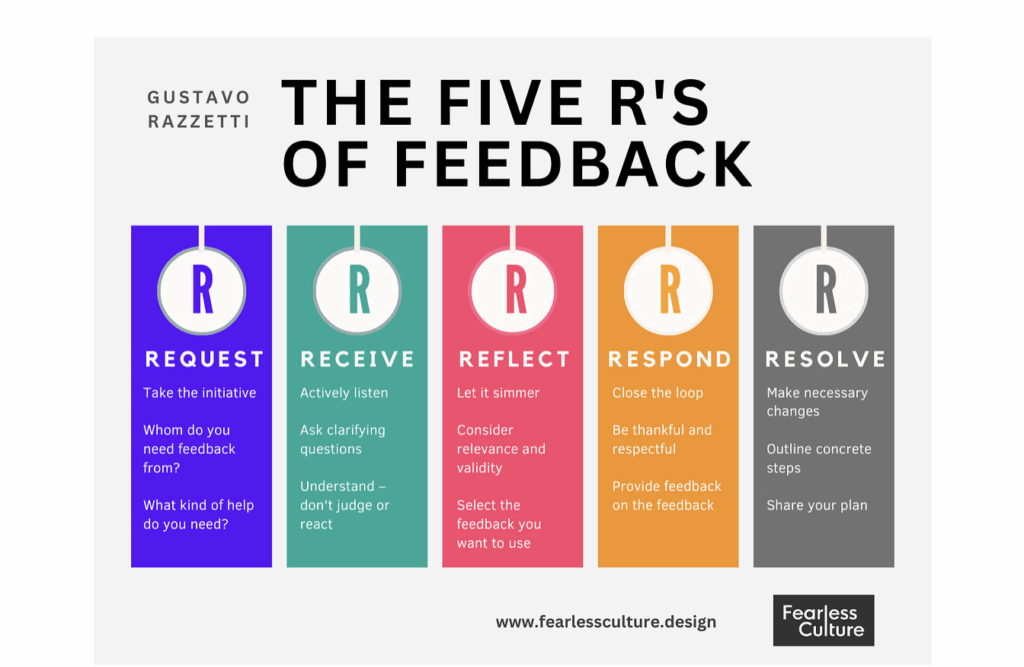
I often refer to leaders I like to follow on the networks. Gusttavo Razzetti (author and expert in corporate culture) sums up the process of receiving feedback very well through his framework: the Five R's of Feedback.
It proposes five simple steps to transform feedback into a real learning lever: Receive - Reflect - Respond - Reframe - Resolve
- Receive : welcome feedback with openness.
- Reflect : take a step back to grasp their meaning.
- Respond : exchange, clarify, thank.
- Reframe : change perspective to learn from it.
- Resolve : deciding what to do with it, and coming full circle with the person who shared it with you.
You have to learn to receive feedback. And above all, you have to practice. Nobody is naturally at ease with criticism, and perhaps even less so when you're a Manager. But like all interpersonal skills, it can only be developed with awareness, practice and a genuine desire to progress.
Here are the qualities you need to cultivate to turn feedback into a positive experience, a real growth driver :
1. Active listening
Listening doesn't simply mean keeping quiet while the other person talks.
It means trying to understand the message behind the words, beyond the tone or formulation. Rephrase to check your understanding:
«If I understand correctly, you mean that...» : this simple sentence opens up a space for dialogue and shows that you take feedback seriously.
2. Empathy and curiosity
Try to put yourself in the other person's shoes.
Why is he telling you this? What positive intention lies behind his words?
Even if you disagree, try to understand where his or her point of view comes from. This genuine curiosity is often the key to turning perceived negative feedback into useful learning.
3. Humility
Feedback doesn't question your value. It doesn't say «who you are», but simply «what you do» in a given context.
Receiving feedback with humility means accepting that there is always room for improvement, and that it's a chance to become aware of it.
4. Kindness
Don't forget that giving feedback takes courage.
Anyone who dares to share feedback takes a risk: the risk of displeasing you, of hurting your feelings, or of being misunderstood. Acknowledging this courage is a sign of leadership. A sympathetic ear defuses tension and opens the way to more constructive exchanges.
5. Gratitude
Say thank you. Always.
Even if the feedback unsettles you, even if you disagree, express your gratitude for the other person's time, energy and intention. You can always step back afterwards and decide what to do with it.
And above all... don't take anything personally. This is one of the famous four toltec agreements. And it applies perfectly here.
Feedback is as much about the giver as the receiver. It reflects a perception, a context, an experience, not an absolute truth. By not taking it personally, you can free yourself from emotional reaction and focus on useful information.
Receiving feedback is much more than a communication exercise.
It's a essential leadership skills, which impacts both individual performance and collective dynamics.
For the employee
Feedback offers many concrete benefits:
- Understanding expectations and perceptions. It helps you find out how your work is really perceived, detect misunderstandings and clarify priorities.
- Building confidence and motivation. A constructive, benevolent feedback gives value to your strong points and shows that your efforts are seen and recognised.
- Identify concrete avenues for development. Feedback highlights areas for improvement, offers new perspectives and stimulates continuous learning.
- Getting out of your comfort zone It opens up the possibility of discovering angles you might not have thought of, testing new approaches and making faster progress.
For the company
Feedback also has a direct impact on collective performance:
Employee commitment and loyalty. Those who feel listened to and supported are more motivated, more loyal and become natural ambassadors for the company.
Strengthening transparency and trust. A feedback culture fosters open and sincere exchange between teams and managers, and reduces tensions and misunderstandings.
Improving collaboration. Understanding each other's expectations and perceptions enables us to work better together, anticipate needs and align efforts.
Managers in close contact with their teams. Regular exchanges create a more human, more authentic relationship, and facilitate the early detection of difficulties. For the manager, asking for feedback is also a sign of vulnerability. Today, vulnerability has been identified as a key leadership skill.
Receiving feedback is something I've learned over the years, and believe me, it's never easy.
Some feedback makes us happy, some stings a bit... and some makes us think for days. But every time, it's an opportunity to get to know each other better.
For me, the true art of feedback lies in this balance: knowing how to listen without defending oneself, knowing how to welcome without accepting everything, knowing how to digest in order to transform into concrete action. It's a bit like holding up a mirror: what you see is not a judgment, it's an opportunity to adjust and grow.
I've seen so many leaders and employees evolve simply because they've learned to welcome feedback from others with curiosity and humility, rather than with fear or resistance. And I can assure you that it's these moments that make all the difference, not only in your work but also in your professional relationships.
If you'd like to take this step, to transform feedback into a real development lever - for you, your teams and your organisation - that's exactly what I propose in the Laughing Willow leadership programs.
So, are you ready to reveal your inner leader?
#spreadyourwings