
Process Communication Model®: communicate, collaborate and manage better every day
Why do some teams collaborate smoothly, while others struggle to understand one another despite the best of intentions?
The answer can often be found in our communication methods. We all have different needs, motivations, and ways of working. When we learn to recognise these, relationships become simpler, exchanges more effective, and working together more natural.
This is precisely what the Process Communication Model® (PCM) allows.
PCM helps to understand the mechanisms that influence our behaviours, our communication and our reactions, particularly during periods of pressure. It allows us to put words to situations we experience every day, without always understanding them.
From NASA to companies: the story of PCM
The story of PCM began in an environment where the quality of communication could make all the difference: NASA.
Research conducted at the time highlighted a reality: performance difficulties were generally not linked to a lack of technical skills. They were primarily linked to communication breakdowns under pressure. NASA then wanted to better understand how individuals think, communicate, and react in real-life situations.
It is in this context that psychologist Taibi Kahler developed the Process Communication Model®, subsequently used for several decades by NASA, particularly in the selection and support of its astronauts.
In our organisations, pressure is a part of daily life: ambitious objectives, tight deadlines, constant transformation, a multiplying number of contacts. In this environment, speaking the same language becomes a formidable lever for efficiency. When teams understand each other better: decisions are more fluid, collaborations improve in quality, tensions are resolved more quickly, engagement progresses naturally.
Developed from decades of research and used in high-performance environments across the globe, PCM offers a simple, pragmatic and immediately applicable framework.
3 reasons to integrate PCM into your leadership
1. A simple tool... and incredibly rich
In less than an hour, everyone can discover the model and their profile. And yet, PCM never reduces individuals to a simple label.
We all possess all six personality types from the model. The difference lies in their organisation and intensity. Each profile is unique. With over 720 possible combinations, PCM offers a nuanced and profoundly human insight into personality.
I particularly appreciate this approach, which allows for a better understanding of differences without ever pigeonholing people.
2. An immediately operational tool
PCM allows us to understand:
- our preferred communication style
- our deep motivations
- our natural forces
- our predictable reactions under pressure
- the psychological needs that fuel our energy
Very quickly, managers find answers to concrete questions:
- How to motivate this person?
- Why does this colleague go quiet in certain situations?
- How to defuse tension in the team?
- How to adapt my message to be truly heard?
- How to give feedback that generates buy-in?
Often, PCM simply puts words to situations experienced for years.
Participants regularly tell me: «Now I understand why that person behaves like that.» or else: »I'm finally realising what's draining my energy.»
These realisations change a lot of things.
3. A playful tool that develops relational agility
PCM invites us to explore differences with curiosity and kindness.
We learn to recognise others' preferences and adjust our communication accordingly.
Little by little, we are developing greater relational flexibility. And this flexibility transforms leadership, teamwork, everyday conversations, and the ability to build trusting relationships.
Understanding PCM
PCM identifies six personality types:
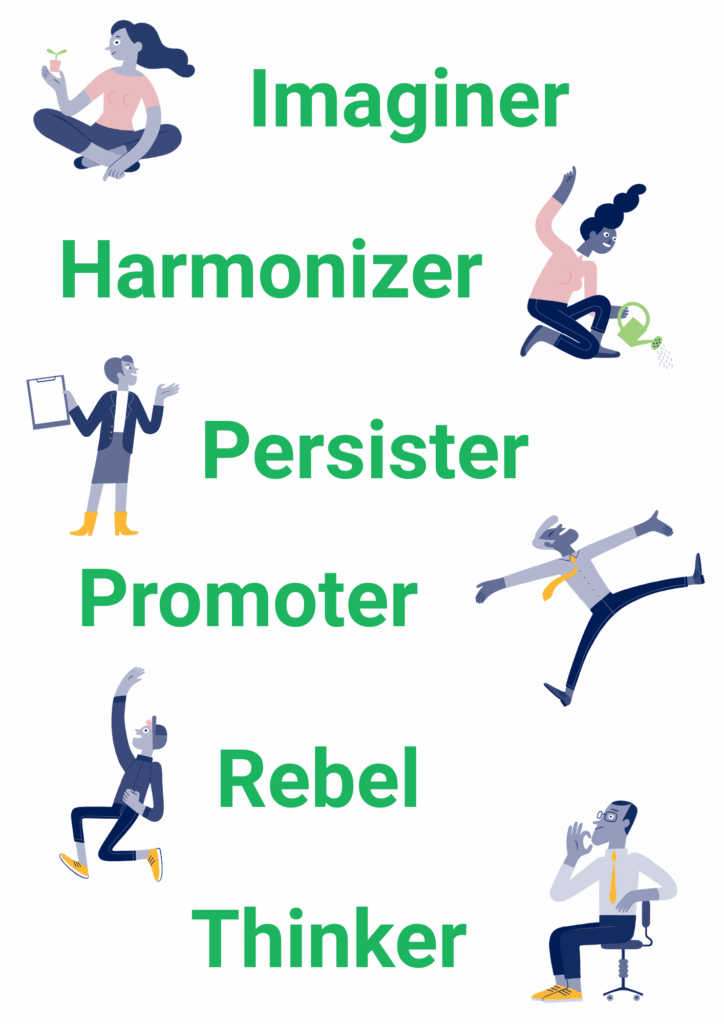
We all possess these six types within us. The difference lies in their order of appearance and their level of development.
The base
It notably influences:
- our most spontaneous reactions
- Our dominant strengths
- our essential psychological needs
- our natural way of communicating
The phase
During our lives, our main sources of motivation can evolve. PCM calls this the Phase.
When we change phase, another type of personality becomes the primary driver of our motivation. In other words: we perceive the world through our Base, but we make our decisions through our Phase.
The principle of the lift
Imagine a six-storey building. Each floor represents one of six personality types. When our psychological needs are met, the lift works perfectly. We can easily access all our resources and bring out the best in ourselves. Our adaptability increases. Our leadership does too.
When certain needs remain unmet, the lift gets stuck. We then find it more difficult to use our resources and adopt stress-related behaviours.
This image often helps participants to immediately understand what is happening in their daily lives.
How can you apply PCM in your daily life?
For the most curious among you, I recommend the book: Practising Process Communication® in daily life by Jérôme Lefeuvre.
And to go further?
At The Laughing Willow, we support leaders, managers and teams in the concrete appropriation of PCM.
Discover
An immersive introduction for:
- Understanding the model's logic
- Discover its applications in leadership
- to experiment with different ways of communicating and motivating
2. Explore and diagnose
An essential step in self-knowledge.
Participants discover:
- their individual profile
- their motivational engines
- their stress triggers
- their natural resources
It's often the time for big «aha moments», as I like to call them. The moment when you finally understand certain reactions, certain behaviours, and certain relational dynamics.
And very quickly, a new interpretation of others also appears: «I understand better why this person is reacting like this,» «I now see what truly motivates them»
3. Deployment
Theory becomes practice. We work from real-life situations: meetings, feedback, decision-making, managing tension, inter-team collaboration.
We build personalised and directly applicable relationship strategies together. I guide you through this stage with simple, concrete exercises that are easy to reuse daily.
PCM is a tool that I regularly integrate into larger projects, for example with newly formed teams and/or those that wish to strengthen their cohesion, with organisations undergoing transformation, with managers who wish to develop their impact, their influence and their relational maturity. PCM is also very widely deployed in
• Conflict prevention and resolution
• Recruitment assistance
• Sales, negotiation, customer service
• Presentation and facilitation techniques
• Coaching, consulting, personal development
• Nurse-patient helping relationship
• Teaching and education
An organisation's quality always rests on the quality of the relationships that constitute it. PCM offers a common language to make these conversations smoother, more constructive, and more human. And it is often where the most lasting transformations begin.
Discover The Laughing Willow PCM approach and contact me to put it into practice.